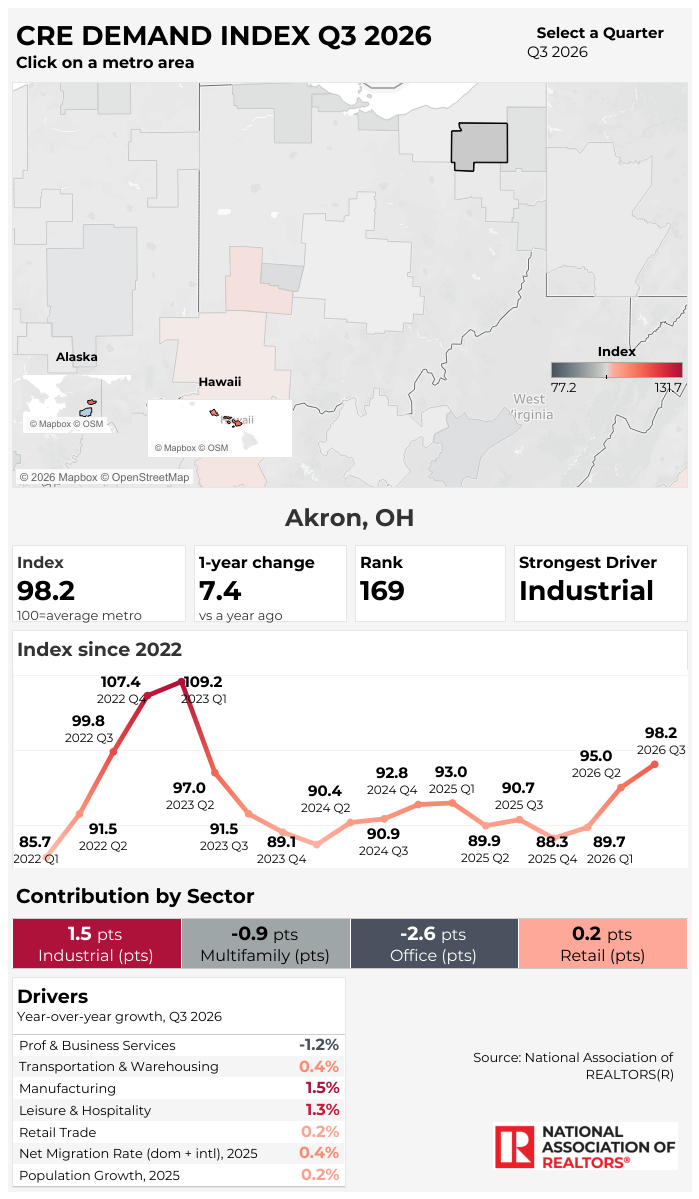
Akron’s commercial real estate market continued to gain ground in the third quarter of 2026. The Akron Commercial Real Estate Demand Index reached 98.2 in Q3, up 3.2 points from the previous quarter and 7.4 points from a year ago.
While Akron remains just below the national benchmark of 100, the latest numbers show continued improvement from the market’s recent low of 88.3 in late 2025.
Industrial activity remains Akron’s strongest commercial real estate demand driver.
Industrial Leads the Way
Akron ranked 169th among the 306 metropolitan areas tracked by the National Association of REALTORS® (NAR). Its strongest-performing sector was industrial, which contributed 1.5 points to the overall index.
The sector breakdown shows a mixed picture across the market:
- Industrial: +1.5 points — The strongest contributor to Akron’s overall index.
- Retail: +0.2 points — A modest positive contribution.
- Multifamily: -0.9 points — Population and migration trends continue to weigh on this sector.
- Office: -2.6 points — The largest drag on Akron’s overall score.
The results reinforce the importance of manufacturing, transportation and warehousing activity to Akron’s commercial real estate outlook. They also show that improvement in one sector does not necessarily translate into growth across the entire market.
What This Means for Akron’s Commercial Market
Akron’s improving index is encouraging, particularly for practitioners working in industrial real estate. Continued attention to manufacturing investment, transportation infrastructure, site readiness and redevelopment of existing industrial properties will be important as the market works to build on this momentum.
The office sector remains a challenge, while the modest retail contribution suggests that retail-related employment is not yet providing significant momentum to the overall index.
For commercial REALTORS®, developers and investors, the numbers offer another reason to look closely at the economic activity behind a property or potential development site. Employment trends, business expansion and population changes can help identify where future demand may develop.
Understanding the Index
NAR’s Commercial Real Estate Demand Index measures the economic conditions that can support future demand for office, industrial, retail and multifamily properties across 306 metropolitan areas.
A score of 100 represents the average metro area. Scores above 100 indicate stronger-than-average demand drivers, while scores below 100 indicate weaker relative momentum. A score below 100 does not necessarily mean a market is shrinking.
The index tracks employment growth in professional and business services, manufacturing, transportation and warehousing, retail trade, and leisure and hospitality. Population growth and domestic and international migration are also included.
It is important to note that the index does not measure vacancy rates, rents, absorption or actual leasing activity. It is designed to provide an early look at the local economic conditions that may influence commercial real estate demand.
The takeaway: Akron is moving in the right direction, with industrial activity continuing to lead the way. The next challenge will be building broader momentum across the other commercial property sectors.
Source: National Association of REALTORS®, Commercial Real Estate Demand Index, Q3 2026.

Recent Posts
November 13, 2026
Cleveland Commercial Real Estate Demand Holds Near National Average, with Retail Leading the Way
November 12, 2026
Akron Commercial Real Estate Demand Continues to Improve, Led by Industrial Activity

November 4, 2026
ACAR Statement on Passage of Akron Charter Issues 11 and 12

November 4, 2026
2026 Election Recap: Results Across Cuyahoga, Summit and Portage Counties
October 30, 2026